


5 Questions That Will Help You Select The Most Suitable Brake Pads
Brakes & Safety3 October 2026
Choosing the right brake pads matters for safety and performance. Ask these five key questions before selecting brake pads for your vehicle.
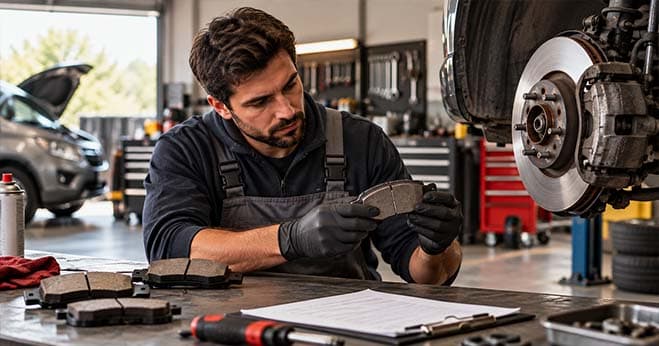
Your car’s brakes are one of its most important safety systems, yet they are easy to ignore until a squeal or a grind shows up. When it is time for new brake pads, the first option on the shelf is rarely the right one, and price on its own is a poor guide. The vehicle, the way you drive, and what you want from the brakes — quiet running, long life, or strong stopping power — all change which pad is the sensible choice.
These five questions will point you towards pads that suit your car. The mechanics at Patel Auto Service can then match the correct pads to the vehicle and the way it is used.
Table of Contents
- Question 1: What Type of Driving Do You Do Most?
- Question 2: What Material Is the Brake Pad Made From?
- Question 3: Does the Pad Suit Your Vehicle and How You Drive It?
- Question 4: What's Your Budget vs Long-Term Value?
- Question 5: Are You Replacing Pads With Rotors, or Pads Alone?
- Warning Signs Your Brake Pads Need Attention
- Get the Right Brake Pads for Your Car with Patel Auto
- Frequently Asked Questions (FAQ)
Question 1: What Type of Driving Do You Do Most?
Different driving puts different stress on the brakes. If most of your kilometres are in the city — school runs, stop-start traffic, and peak-hour queues — the pads heat up and cool down over and over. That cycle wears them faster and can produce more brake dust and noise than other driving styles.
Highway driving usually means fewer stops, even when those stops are firmer, so the pads often wear more slowly. Mixed driving, a bit of both, is very common for Australian motorists and calls for a versatile, all-round pad.
An honest description of your usual driving helps the pads wear more evenly, and it is a safety decision as much as a parts decision. Braking and tyre condition belong in the same check, so it is worth including them in a wider safety and tyre inspection.
Question 2: What Material Is the Brake Pad Made From?
Most passenger-car pads fall into three materials, and each one trades something off.
- Organic pads are made from fibre, rubber and resin. They are relatively quiet and kind to the rotors, but they do not last as long and can lose some bite under hard braking. They suit small cars used for everyday driving.
- Semi-metallic pads use metal fibres to shed heat and stop firmly. They last well and cope with harder use, though they are often noisier and make more dust than organic pads.
- Ceramic pads sit between the two on noise, wheel cleanliness and life, at a higher price. They are a common choice for everyday drivers who want quality without a lot of noise or dust.
There is no single best material. The right one is the one that matches what you need. If a quiet car and cleaner wheels matter most, ceramic pads can be worth the extra cost.
Brake Pad Material Comparison
Use this as a quick comparison before you choose a compound.
- Organic — Quiet, gentle on rotors, shorter lifespan, moderate dust. Best for small cars and daily city driving.
- Semi-metallic — Strong, handles heat well, noisier, more dust. Best for heavy driving, towing and performance cars.
- Ceramic — Long-lasting, very quiet, little dust, costs more. Best for daily drivers who want less noise and cleaner wheels.
Question 3: Does the Pad Suit Your Vehicle and How You Drive It?
Material is only half the match. The pad also has to suit the weight, power and job of the car. An SUV or a vehicle that tows loads the brakes far more than a light sedan, and pads made for a small car will not stand up to that stress. A pad chosen for the vehicle keeps stopping performance where it should be.
An OEM-spec pad is designed to feel like the original brakes and is a reliable choice for regular driving. Performance pads cope with higher temperatures and harder stops, which suits aggressive driving or carrying loads. On a car that mostly does the school run, those pads are often more than you need, and they can be noisy.
Brakes, suspension and steering work together to keep the car stable. A suspension and steering check can show whether a handling fault is affecting how the brakes do their job. Worn suspension parts, for example, can shift weight poorly under braking and make even the right pads less effective.
Question 4: What's Your Budget vs Long-Term Value?
The cheapest pads can look like a saving until you count the rest of the job. Lower-quality pads often wear out sooner, and uneven wear can score the rotors. A simple pad change then becomes a rotor replacement, which costs more. Cheap pads also tend to make more dust and more squeal, so the early saving is easy to regret.
Better pads cost more up front. They usually last longer, stop more consistently, and are kinder to the rest of the brake system. Compare the cost per kilometre. A pad that costs more but lasts twice as long is often the cheaper choice over time, and it gives you more consistent braking.
Question 5: Are You Replacing Pads With Rotors, or Pads Alone?
Sometimes new pads are all the car needs. If the rotors are worn thin, warped or scored, pads alone will not fix the problem. New pads on damaged rotors wear badly, vibrate through the pedal, and stop poorly from the first drive.
Rotor condition is easy to miss without a proper look. A brake inspection as part of a general automotive inspection shows whether the discs still have usable life, or whether they should be replaced with the pads.
Warning Signs Your Brake Pads Need Attention
Even with the right pads fitted, wear still needs to be caught early. Have the brakes checked if you notice any of these:
- Squeaking or grinding when you press the brakes
- A longer stopping distance than usual
- Vibration or pulsing through the brake pedal
- A brake warning light on the dashboard
- A burning smell after braking
Those signs are worth acting on straight away. An inspection can stop a small fault from turning into a larger, more expensive repair.
Get the Right Brake Pads for Your Car with Patel Auto
Choosing brake pads comes down to how you drive, what you drive, and which part of braking matters most to you. A mechanic can weigh those factors and fit the right pads, rather than whatever happens to be on special.
If you have noticed any of the signs above, or you are due for a brake check, Patel Auto Service can inspect the brakes and recommend pads for your car and your driving. Book a brake inspection and drive with more confidence.
Frequently Asked Questions (FAQ)
- How often should brake pads typically be replaced?
- It depends on how and where you drive. Brake pads commonly last between 30,000 and 70,000 kilometres. City driving with lots of stops wears them faster than highway driving.
- Can I replace just my brake pads without changing the rotors?
- Yes, if the rotors are still smooth, thick enough, and not warped or scored. If the discs are worn out, new pads alone will wear unevenly and the brakes will not perform properly.
- Why do my new brake pads make a sharp noise?
- New pads can squeak lightly while they bed in against the rotor surface. If the noise continues, or it turns into a grind, have a mechanic check the installation.
- Are ceramic brake pads worth the extra cost?
- For daily commuting, they often are. Ceramic pads make very little brake dust, run quieter than semi-metallic pads, and tend to last a long time.